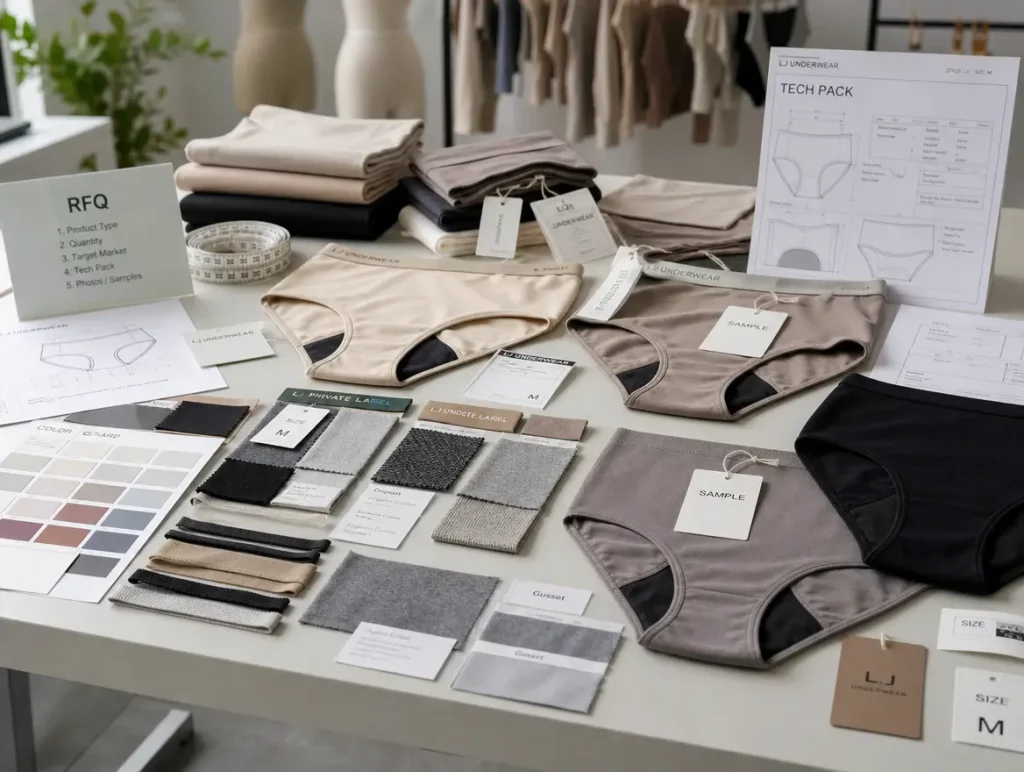
Washable Care Product Development
Custom Incontinence Underwear Manufacturer for Private Label
As a custom incontinence underwear manufacturer, LJUNDERWEAR develops washable women's and men's styles for private-label brands, retailers and care-focused programs. The LJUNDERWEAR team in Shantou brings pattern development, gusset assembly, quality checks and packing into one workflow.
Before sampling, LJUNDERWEAR confirms the wearer, protection zone, fit and care routine. Capacity, surface dryness, leakage, sizes, MOQ and timing are then agreed for the selected design.

Product Options
Which Washable Incontinence Underwear Styles Can You Source?
Available starting points include women's briefs, high-rise briefs, boyshorts, plus-size styles and men's briefs or boxer briefs. Choose the body style first, then adjust the protection area, fit and materials for the intended wearer and market.
| Style | Best suited for | Main points to confirm |
|---|---|---|
| Women's brief | Wellness, retail or care ranges | Discreet fit, front-to-back placement, rise and leg security |
| Women's high-rise or full-coverage brief | Buyers needing more body and back coverage | Waist comfort, coverage stability and graded fit |
| Women's boyshort | Buyers prioritizing leg coverage | Protection width, inner-leg bulk and movement |
| Men's brief or boxer | Men's care and wellness ranges | Front-zone placement, opening construction and product-specific grading |
| Extended-coverage brief | Programs that need a larger protected area | Layer coverage, surface dryness, drying time and wash testing |
These styles are starting references, not fixed specifications. Final absorbency, size range, care instructions and product claims must match the approved sample and test records for your order.
Current Product References
Compare Current Functional Underwear Styles
Use these six current catalog styles to compare briefs, boxer shorts and boyshort silhouettes. They can guide early decisions about shape, coverage and fit before LJUNDERWEAR confirms the materials, measurements and testing for your project.

Men's boxer brief
B27 Men's Incontinence Boxer Brief
A men's boxer-brief route for reviewing coverage direction, open-fly construction, waistband stability and size grading.
View product details
Women's boxer short
C169 Cotton Boxer Period Short
A mid-rise cotton boxer route for reviewing leg length, waistband stability, gusset placement and extended size grading.
View product details
Men's fit
Men's Incontinence Boxer-Brief Route
A men's boxer brief for reviewing front protection, insert handling, fit and size grading.
View product details
Women's boyshort
Women's Incontinence Boyshort Route
A longer-leg women's option for reviewing leg coverage, seam placement and movement.
View product details
Women's cotton short
Mid-Rise Cotton Menstrual Short
A cotton short route for reviewing inseam, center-panel construction, color options and private-label development.
View product details
Seamless boy-short
IY001 Seamless Period Boy-Short
A bonded boy-short route for reviewing no-show edges, leg opening, gusset placement and private-label color approval.
View product detailsCatalog pages are style references. Capacity, care, sizes, MOQ and performance wording are confirmed for the selected sample and order.
Use Definition
Who Will Wear the Product, and Where Is Protection Needed?
Start with four practical decisions: who will wear it, where protection is needed, how the garment should fit and how it will be washed. These answers guide the pattern, layer placement and sample plan.
Keep the brief product-focused. Describe fit, care and function without presenting the underwear as a diagnosis, treatment or recovery product.
The brief should record:
- Intended wearer and whether the style is women's or men's
- Light bladder leaks or another agreed use
- Typical daily activity and wear duration to be evaluated
- Leakage direction and target protection area
- Primary or backup protection and expected wearing context
- Desired silhouette, rise and back coverage
- Dressing, handling and ease-of-use requirements
- Washing, labeling, sales channel and market documentation
Protection-Zone Map
Where Should the Protection Zone Sit?
The protected area must be planned with the garment pattern. Its front rise, back coverage and width may differ between women's and men's products, and between briefs and boxer briefs.
Garment and layer decisions must be approved together
| Design area | Question to answer | What to approve |
|---|---|---|
| Front protection | Where does liquid first contact the garment? | Pattern overlay and sample notes |
| Central absorbent core | How much coverage and thickness are needed? | Layer layout and material list |
| Back extension | Is added rear coverage required by the defined use? | Pattern dimensions by approved size |
| Side transition | Can liquid bypass the core near seams or leg openings? | Construction check and leakage observation |
| Waist and leg openings | Does the garment stay positioned without excessive pressure? | Fit comments and measurements |
| Outer fabric | Is the appearance discreet while stretch and opacity remain stable? | Material approval and graded-size review |
The protection zone should stay in place during movement and across the approved size range. Use the private-label fit and grading guide to prepare base measurements and fitting sizes.
Testing Plan
What Should Be Tested Before You Order?
Testing should cover absorbency, intake speed, surface dryness (rewet), leakage, thickness, drying and wash durability. These results are connected: more capacity may also mean a thicker product, longer drying time or a different fit.
| Performance area | Why it matters | What must be defined |
|---|---|---|
| Absorbency and intake | Shows how much liquid the construction retains and how quickly it receives it | Liquid, dose, timing, total volume and endpoint |
| Surface dryness (rewet) | Shows how much moisture returns to the skin-side surface under pressure | Pressure, contact material and timing |
| Leakage | Evaluates liquid passing beyond the intended barrier or edge | Position, movement or pressure condition |
| Bulk and fit | Checks whether layer thickness affects appearance, movement or garment position | Layer thickness, location and approved sizes |
| Wash and drying durability | Checks whether the construction and care method remain suitable for repeat use | Wash cycles, drying method, sample identity and observations |
If the product claim changes, update the test plan before approving packaging. A result for one material or prototype does not prove the performance of the finished bulk order.
Graded Fit Approval
How Do You Approve Fit Across the Size Range?
Fit development should begin with the target market's size system and body data. Women's and men's products should not share one grading rule unless the pattern and fit review support it.
Fit representative sizes and review rise, waist tension, leg openings, protection placement, back coverage and ease of dressing. If the product has an opening or adjustable feature, include it in the sample review.
The finished size range is confirmed after choosing the base pattern, checking fabric stretch, placing the absorbent layers and fitting representative sizes. Any extended-size claim should match the current approved product record.
Material System
Which Materials and Care Instructions Need Approval?
Body fabric, skin-side fabric, absorbent layers, barrier film, elastic and thread work as one system. Softness matters, but the materials must also meet the required stretch, coverage, seam and washing needs.
Body and skin-side fabrics
- Composition, weight, stretch and recovery
- Hand feel, opacity, color and supplier reference
Core and barrier system
- Coverage, thickness and layer placement
- Barrier reference, edge construction and agreed tests
Trims, labels and washing
- Elastic, thread, seam and label requirements
- Washing temperature, detergent limits and drying method
Use the Fabric Guide to compare options, then record the approved composition, stretch, color, supplier reference and care method in the product specification.
Eight Approval Gates
How Does a Project Move From Brief to Bulk Production?
LJUNDERWEAR moves the project through eight documented decisions from intended use to bulk control. Each stage should produce an approval record or an agreed project input.
- USEConfirm the wearer, leakage boundary, daily context and sales channel.
- FITSelect the silhouette, base block, rise, coverage and representative sizes.
- PROTECTIONMap the absorbent and barrier zones around the garment pattern.
- MATERIALApprove body, contact, absorbent, barrier and elastic components.
- SAMPLEReview measurements, workmanship, comfort and protection placement.
- VALIDATEComplete the agreed absorbency, intake, rewet, leakage and wash checks.
- LOCKApprove the sealed sample, bill of materials, labels, care copy and packaging.
- CONTROLInspect bulk measurements, construction, layer alignment, labeling and packing.
The detailed sample-development workflow can be used to separate feasibility, sample revisions and pre-production approval.
Order Documents
Which Documents and Quality Checks Support Your Order?
Product claims should match the approved test results. Product pages and packaging should describe fit, care and function without claiming that the underwear diagnoses, prevents, treats or cures a medical condition.
Documents must match the order
Your project file can combine material records, supplier declarations, test reports, care instructions, measurements and inspection records. Each certificate applies only to the holder and scope stated in its file.
Current management-system listings shown on the LJUNDERWEAR Certifications page include:
62726Q00153R00162726E00103R001Use the LJUNDERWEAR Document Center to identify the records needed for your selected product and market.
Bulk inspection can cover
Agree the inspection points and acceptance rules before production. Typical checks can include:
- Protection-zone position and layer alignment
- Seam security or bond condition
- Waist and leg measurements
- Elastic recovery and visible distortion
- Labels, care instructions and SKU identification
- Packaging count, size, color and barcode details
- Agreed functional inspection
The inspection plan should name the sample, method, frequency and acceptance criteria for the order.
Supplier Due Diligence
What Can Buyers Verify About This Incontinence Underwear Manufacturer?
LJUNDERWEAR has operated since 2015, with manufacturing in Shantou and a sales and compliance office in Shenzhen. The LJUNDERWEAR company story and factory overview show the main steps from product brief and pattern making to sewing, packing and outgoing quality control.


| Buyer due-diligence question | Publicly documented LJUNDERWEAR evidence | What remains project-specific |
|---|---|---|
| Can the supplier develop the pattern before production? | The workflow includes an order-briefing stage, pattern room and prototype sewing. | Block selection, pattern ownership, revision count and approval sizes |
| Can the factory assemble functional underwear? | The factory overview shows multi-layer gusset assembly, waistband sewing and TPU-lamination-related operations. | The exact layer map, machinery route and operator standard for the selected style |
| Is quality checked during production? | The published workflow includes sealed-sample line setup, in-process QC checkpoints and outgoing quality control before loading. | Inspection level, sampling plan, defect criteria and agreed functional checks |
| Can private-label details be handled? | The packaging stage covers care labels, hang tags, size stickers, polybags, boxes and channel-specific packing. | Artwork approval, barcode data, packaging materials and market labeling rules |
| Are documents traceable to the product? | The Certifications page lists current company-level certificate and report entries, while the Document Center provides technical and commercial working documents. | Holder, validity, sample or component, test method, result and applicability to the order |
These records help buyers review the supplier, but they do not prove every finished-product claim. Ask for documents that match the approved materials, sample and destination market for your order.
Procurement Input
What Information Should You Send for a Quote?
Send the intended wearer, use, reference product or drawing, preferred style, protection area, performance target, materials, sizes, quantity, branding, packaging, target market and delivery destination.
List men's products, higher-capacity targets, adaptive details or care-institution requirements as separate style briefs because they may need different patterns and testing.
Buyer Questions
Common Questions About Incontinence Underwear Manufacturing
What is the difference between incontinence underwear and period underwear?
Incontinence underwear is designed around adult leakage direction, daily use and fit. Period underwear is designed for menstrual use. Some materials may be similar, but protection placement, sizing, claims and care instructions should be specified separately. See the guide: can period underwear be used for incontinence?
Does LJUNDERWEAR manufacture disposable adult diapers?
No. This page covers washable underwear, not disposable adult diapers. Disposable products use different materials, machinery, testing and packaging.
Can you develop women's and men's incontinence underwear?
Yes. The LJUNDERWEAR catalog includes women's and men's starting styles. Protection placement, fit and size grading are then developed for the selected product.
How is absorbency measured?
The test should name the sample, liquid, volume, application rate and endpoint. Absorbency, surface dryness and leakage are recorded separately because they measure different aspects of performance. See how absorbent layers work.
How do you evaluate rewet and surface dryness?
A rewet test measures how much moisture returns to the skin-side surface under defined pressure and timing. Product wording should follow the approved result rather than promise absolute dryness.
Can the underwear be developed in an extended size range?
Yes. LJUNDERWEAR lists a plus-size starting style. The final size range is confirmed through the base pattern, fabric stretch, protection placement and representative-size fittings.
What documents are available for a private-label order?
The project file may include material documents, measurement sheets, sample approvals, care instructions, test reports and inspection records. LJUNDERWEAR confirms which documents apply to the selected materials and order.
What is the MOQ and sample lead time for custom incontinence underwear?
MOQ and sample timing depend on the construction, materials, sizes and quantity. Send your product reference, intended use, size range, branding, packaging and estimated order quantity for a project-specific quotation.
Development Review
Ready to Plan Your Incontinence Underwear Project?
Start With the Wearer, Fit and Protection Needs
Send your product reference, intended use, preferred fit, performance needs, sizes and estimated quantity. LJUNDERWEAR will review the open decisions, sampling steps and quotation.
Get Your Free Quote & Technical Review
How To Submit Your RFQ
1.Send product type, quantity, and target market.
2.Attach tech packs, photos, or samples.
3.Get sample, MOQ, cost, and timeline guidance.