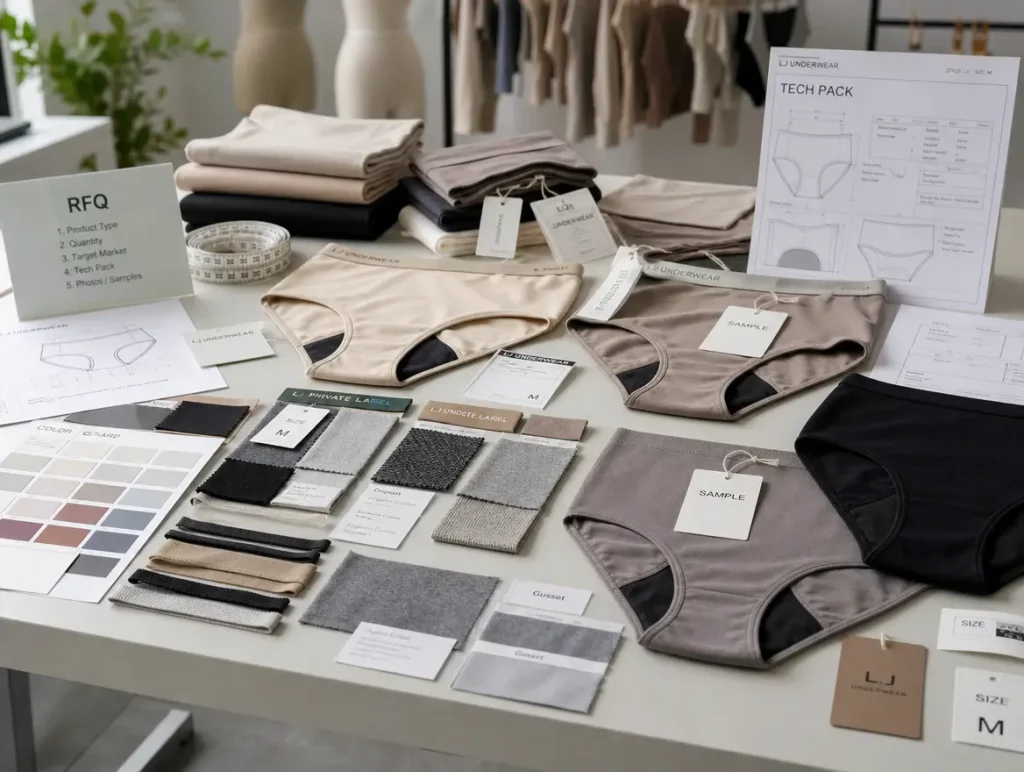
Custom postpartum product development
Custom Postpartum Underwear Manufacturer for OEM and Private Label Brands
LJUNDERWEAR is a China-based custom postpartum underwear manufacturer supporting reusable OEM/ODM programs for maternity brands, period-care labels, retailers and distributors. Founded in 2015, the company combines production in Shantou with sales and compliance coordination in Shenzhen.

Product route
What Postpartum Underwear Can Private Label Brands Develop?
Postpartum underwear can be absorbent, comfort-led, high coverage or part of a coordinated maternity range. Start with the wearer need, then define the construction. For a published product starting point, browse the period panties for postpartum range.
Reusable absorbent brief
Choose the coverage area, absorbency direction, thickness and care method.
High-rise full-coverage brief
Compare rise, waistband comfort, back coverage and size grading.
Soft-waistband brief
Balance gentle contact, stretch recovery and changing fit needs.
Extended-back style
Extend rear coverage while keeping the edges secure during movement.
Coordinated postpartum set
Color, material story, labeling, packaging and SKU planning.
This page covers reusable postpartum underwear. Disposable products require a separate material and production route. For sample sign-off, use the sample approval checklist for private-label underwear buyers to keep measurements, appearance and approval records traceable.
Use-stage decisions
How Should a Postnatal or C-Section Recovery Underwear Brief Change by Stage?
Postpartum, or postnatal, underwear is a lower-body product route defined by the intended wear stage, coverage and care requirements. A postpartum recovery underwear supplier should set those conditions before sampling, rather than treating every after-birth or maternity brief as the same product.
Briefs can be specified for higher coverage, a longer protection zone and a stable waist position. Confirm the intended use, surface contact, core bulk and care route on the named sample.
Briefs can move toward lighter bulk, changing waist placement and everyday comfort. Review the fit block and material recovery across representative sizes before approving the range.
C-section recovery underwear requires separate product, medical-claim and market review. Identify that route in the product brief so it can be evaluated independently; do not assume that a standard postpartum brief is appropriate around a surgical incision.
| Decision | Define on the named sample | Approval record |
|---|---|---|
| Finished absorbent core | Any ml claim must be measured on the completed absorbent core using an agreed method, not inferred from a component specification. | Sample ID, liquid, volume, application rate and endpoint. |
| Coverage geometry | Set front and back extension, width, edge transition and side-containment trade-offs for the intended use stage. | Pattern version, representative-size fit and bulk assessment. |
| Care durability | When relevant to the selected route, define wash appearance and dimensional review separately from absorbency claims. | For a named black knitted brief declared as period underwear, SGS report MCHGZ2601287-01A records a 24 mL synthetic-blood absorption result after 52 pre-wash cycles. It does not establish a default result for every postpartum style. |
Review hand feel, care expectations and contact-layer weight. Compare bamboo and cotton by the selected route.
Compare softness, recovery and care direction with cotton before confirming the specification. See cotton versus modal.
Map the contact, core and barrier roles together; how absorbent layers work explains the decision logic.
Where TPU is selected, match the documented evidence to the named barrier-film sample; do not transfer its scope to every material or finished SKU.
Published maternity products
Which Existing Maternity Styles Can Inform a Postpartum Underwear Brief?
These published maternity styles provide reference silhouettes for coverage, waistband placement, adjustment and color direction before defining a postpartum-specific sample.

High-Waist Maternity Belly Support Panties
Explore high-rise coverage, belly-panel placement and color direction for a maternity or postpartum brief route.
View product details →
Seamless Cotton High-Waist Maternity Brief | W5577
Review waistband finish, back coverage and color assortment before specifying the construction and sample.
View product details →
Low-Waist Cotton Maternity Brief | 0113
Compare low-front waist placement, leg opening and a coordinated color range for the intended wearer.
View product details →
Adjustable Lace High-Waist Maternity Panties
Review the side-adjustment route, lace leg finishing and material direction for a named product brief.
View product details →
Adjustable Elastic High-Waist Maternity Brief
Explore the adjustable-waist route, high-rise fit and coverage direction before developing the sample.
View product details →These are published maternity product references, not proof of postpartum suitability. Approve the final sample for fit, materials, coverage and intended claims.
Fit after birth
How Should Postpartum Underwear Fit After Birth?
Postpartum fit should feel comfortable, secure and easy to wear without promising a medical outcome. Review representative sizes, rise, waist and leg contact, back coverage, protection placement and care.
- Base pattern and size grading
- Front and back coverage
- Waistband width and tension
- Leg-opening pressure points
- Absorbent-area position
- Care and drying route
Use the private-label fit and grading guide to organize measurements and fit comments.
Construction choices
Which Waistband and Coverage Options Fit the Product Brief?
| Design area | Decision | Approval focus |
|---|---|---|
| Waist height | Low, mid or high rise | Position, roll and recovery |
| Construction | Encased, exposed or fabric-covered elastic | Tension, seam contact and wash response |
| Front panel | Standard stretch or softer adaptable panel | Fit change, opacity and stability |
| Leg opening | Elastic, folded, bound or clean edge | Security, pressure and leakage-path risk |
| Protection transition | Functional-layer start and end points | Bulk, stiffness and seam or bond condition |
Products intended for use around a surgical incision need separate product, medical-claim and market review.
Absorbent construction
How Is Reusable Postpartum Underwear Built for Absorbent Protection?
Start with the amount and area of protection the buyer wants. Then balance front-to-back coverage, thickness, garment rise and the test method used for the approved sample.
Skin-side layer
Soft contact and moisture transferAbsorbent core
Absorbency set for the intended useBarrier route
Leak-resistant material in the required areaBody fabric
Stretch, recovery, opacity and care| Area | Development question | Evidence |
|---|---|---|
| Core | What area and target test should the sample meet? | Layer map, method and result |
| Barrier | Where must penetration be resisted? | Material scope and construction review |
| Front | Does the zone begin in the intended position? | Pattern overlay by approved size |
| Back | Is longer rear coverage required? | Pattern dimensions and fit review |
| Side | Can liquid bypass the edge near the leg? | Observation and workmanship check |
Material system
Which Fabrics Work for Washable Postpartum Underwear?
A washable postpartum brief combines body fabric, a skin-contact layer, an absorbent core, a leak-resistant barrier and elastic. Check these parts together for comfort, stretch, opacity, care and fit.
Use the LJUNDERWEAR Fabric Guide for early comparison. Confirm the final material on a sample because changing fabric or elastic can affect fit, comfort and protection placement.
Care labels should follow the tested product. Use medical, hygiene or antibacterial wording only when the finished product has suitable evidence for the target market.
Approval records
How Do You Test Absorbency, Rewet and Wash Durability?
| Area | Define | Retain |
|---|---|---|
| Measurements | Rise, waist, hip, leg, gusset and protection dimensions | Sheet and tolerances |
| Fit | Coverage, waistband, leg security and bulk | Comments by named size |
| Absorption | Liquid, volume, application rate and endpoint | Method and result by sample |
| Rewet | Pressure, timing and contact method | Test record |
| Leakage | Garment position and observation condition | Setup and result |
| Washing | Seam, bond, dimensions and layer condition | Protocol and cycle observations |
Range architecture
Can Postpartum Underwear Coordinate With Maternity and Nursing Products?
Colors, material stories, labels and packaging can align across a range, but each SKU keeps its own claims, size chart, care instructions and functional evidence.
Lower-body fit, protection and care after birth.
Plan a custom panties program for the wider everyday panty family.
Browse period underwear manufacturing.
Sample to bulk
How Does LJUNDERWEAR Develop Postpartum Underwear From Sample to Bulk?
The process moves from product brief to approved sample, then to controlled bulk production.
Use
Confirm product role and reusable care route.
Fit
Define rise, coverage, waist, leg and sizes.
Map
Position protection zone and transitions.
Material
Approve body, contact, core, barrier and elastic.
Sample
Review measurements, contact, appearance and bulk.
Validate
Run agreed fit, absorption, rewet and wash checks.
Package
Approve size, care and product language.
Lock
Seal the production sample and bill of materials.
Bulk
Inspect construction, labels and packing.
Review the Sampling and Development process for feasibility, revision and pre-production approval.

First-party factory evidence
What Factory Capabilities Support Postpartum Underwear Production?
LJUNDERWEAR develops and produces underwear in Gurao Town, Shantou, with sales and compliance coordination in Shenzhen. Buyers can review pattern and prototype work, material preparation, sample approval, sewing, functional-layer assembly, in-process QC, packaging and final inspection.
See the eight-stage factory-floor tour for a closer look at these steps. Production-line allocation and capacity are confirmed for each project after the style and quantity are reviewed.
The product-development approach is led by founder and CPO Sunny Sun. Read the founder profile and meet the team behind sampling, production and quality control.
Document scope
Which Certifications and Records Can Support a Postpartum Program?
26.HCN.12213Check the certificate holder, validity and whether the selected material or product is covered.
62726Q00153R001Covers the stated quality-management entity, site and activities.
62726E00103R001Covers the stated environmental-management entity, site and activities.
EFW726020391Covers the identified TPU barrier-film sample and stated test method.
These records do not automatically certify every postpartum style or order. Match every claim to the selected material, sample and target market. Review the current LJUNDERWEAR certification records.
Quotation inputs
What Should Buyers Include in a Postpartum Underwear RFQ?
Send the product role, reusable construction route, reference garment, rise and coverage, protection direction, target fit, materials, sizes, colors, quantity, labels, packaging, market and evidence requirements.
OEM, ODM and private label
What Commercial Framework Supports a Postpartum Underwear Program?
LJUNDERWEAR can review an existing style, adapt an ODM route or develop a private-label postpartum underwear program. These are indicative commercial benchmarks for applicable underwear routes; the confirmed route depends on construction, materials, colors, size split, packaging and market.
For most applicable underwear routes, the indicative MOQ starts at 50 pcs per colour × per size. Confirm it against the selected style and supply route.
Sample fees are typically USD 25–80 per style. For an eligible first bulk order of 500 pcs or more, the fee is refunded; the quoted scope is confirmed first.
Initial feasibility response is targeted within 12 working hours. A representative prototype averages 72 hours from an approved tech pack; material and transit time are excluded.
Allow about 7 days for a PP sample. After PP approval, indicative bulk production is 25–35 days up to 20,000 pcs or 35–50 days up to 100,000 pcs.
Mutual NDA can be agreed before sampling. Customer data is separated by project, and a supply agreement can include non-competition terms; a 30% deposit reserves the agreed production slot.
These benchmarks are not a universal promise. Every postpartum underwear OEM, ODM, private-label or wholesale program is confirmed against its named sample, approved bill of materials and commercial quotation.
Factory verification context
What Evidence Can Buyers Review Before Starting a Postpartum Program?
LJUNDERWEAR documents its Shantou production base as 22 sewing lines plus 4 lamination lines, with Shenzhen coordinating design, compliance and FBA stocking. Capacity allocation and commercial terms remain project-specific.
This figure refers to brand programs continuing for at least two production seasons, rather than one-off trial orders. It does not predict the outcome of a new program.
Market reach is a company-level reference. Labels, documentation, shipping and product claims still need to be reviewed for the target destination.
LJUNDERWEAR reports an approximate company-level defect rate below 1.5% alongside in-line quality checks and a final AQL 2.5 gate. The quoted inspection plan is confirmed against the product and order.
Buyers can request a factory walkthrough; a 45-minute live visit can be arranged within 48 hours in English, Spanish or French, subject to scheduling.
For marketplace programs, confirm FNSKU, labeling, carton marking, packing and handoff requirements before a production sample is locked. See the Amazon seller route for related preparation context.
Match each material, test, certificate and product claim to its named scope. A documented record is not automatic proof for every postpartum SKU.
For a production, document or sample review, start with the factory-floor overview and the document center, then include the target market and evidence requirements in the product brief.
Buyer questions
Custom Postpartum Underwear FAQ
Use these answers to frame development. Product and commercial details still depend on the approved style.
What is the difference between postpartum and maternity underwear?
Maternity underwear is developed around pregnancy-related fit changes, while postpartum underwear is planned for the specified period after birth. This page focuses on postpartum lower-body fit, coverage, absorbent construction and care rather than nursing bras or pregnancy products.
Is this page for reusable or disposable postpartum underwear?
This page focuses on reusable postpartum underwear. Disposable postpartum pants use different materials and production methods and should be quoted as a separate program.
Can postpartum underwear use an extended protection zone?
Yes, where the intended use and garment pattern require it. Front and back extension, width, edge transition and bulk must be approved on the named sample and reviewed across the selected sizes.
How should the waistband be developed?
Choose the waistband height, width, material, tension and seam route around the intended fit and contact requirements. Comfort should be assessed on the actual sample; it should not be turned into a medical suitability claim.
Can postpartum underwear be offered in extended sizes?
Extended sizing can be reviewed through the selected block, material stretch, protection-layer footprint and representative-size fitting. The final range is confirmed after grading and sample approval.
How is postpartum absorbency tested?
The method should identify the sample, liquid, volume, application rate and endpoint. Rewet, leakage and wash durability should be evaluated separately when the brand intends to make separate claims.
Can postpartum underwear be packaged with maternity or nursing products?
Yes, coordinated colors, labels, inserts and packaging can be reviewed for a multi-product range. Each SKU still needs its own specification, size information, care instructions and evidence.
What is needed for a quotation?
Provide the product role, reusable route, silhouette, fit and protection requirements, materials, sizes, quantities, branding, packaging, target market and documentation needs. MOQ and timing are confirmed after the construction and supply route are reviewed.
What is the MOQ for postpartum underwear?
For most applicable underwear routes, the indicative MOQ starts at 50 pcs per colour × per size. The final MOQ depends on the named style, material, color, size split, packaging and supply route, so it is confirmed in the quotation.
How long do sampling and bulk production take?
Initial feasibility response is targeted within 12 working hours. A representative prototype averages 72 hours from an approved tech pack, excluding material and transit time; a PP sample takes about 7 days. After PP approval, indicative bulk production is 25–35 days up to 20,000 pcs or 35–50 days up to 100,000 pcs, confirmed by project.
Do you support OEM, ODM and private-label postpartum underwear?
Yes. LJUNDERWEAR can review an existing reference style, adapt an ODM route or develop a private-label program. The feasible construction, materials, fit, labels, packaging, MOQ and evidence requirements are agreed against the named product brief.
How is a new postpartum program kept confidential?
Mutual NDA can be agreed before sampling. Customer data is separated by project, and a supply agreement can include non-competition terms for core styles in the same market. The applicable protection is confirmed in the project agreement.
Fit, coverage and verified use
Ready to Develop Your Postpartum Underwear Line?
Send your reference style, product role, fit direction, protection requirements, size range and estimated quantity. LJUNDERWEAR can review the development route, sample plan, open decisions and quotation basis.
Prepare Your Postpartum Product BriefGet Your Free Quote & Technical Review
How To Submit Your RFQ
1.Send product type, quantity, and target market.
2.Attach tech packs, photos, or samples.
3.Get sample, MOQ, cost, and timeline guidance.