Industry insight / Extended-size opportunity
Plus-Size Period Underwear Market: OEM Opportunity for Private Label
Extended-size period underwear is a defensible private-label opportunity only when market proof and fit proof hold together. Buyers should validate who is buying, at what price and in which channel, then connect every proposed size label to body and garment POM, grade rules, representative fit reviews, consistent make and quote-specific unit economics before committing a full range.

At a glance / Buyer decision
How Should Buyers Test a Plus-Size Period Underwear Market Opportunity?
Test the opportunity through three connected records: demand evidence from the target region, verified competitor size coverage and a supplier process that controls extended-size fit and unit economics.
Demand evidence
Define geography, channel, customer and date. Use current search, retailer, review, survey or sales evidence rather than a generic global growth statistic.
Capability evidence
Request the exact size labels, grade rules, POM, block source, material route and representative fit-review records that support the quoted range.
Unit economics
Model material use, pattern work, sampling, returns, size-level inventory and inspection; confirm MOQ and surcharge treatment in the current quote.
Opportunity matrix / Evidence before positioning
A Defensible Plus-Size OEM Line Needs Market Proof and Fit Proof
Use two evidence tracks in parallel. A demand signal without delivery capability creates risk; capability without target-market evidence creates inventory risk. Brands that pass both gates can then compare the evidence with the private-label OEM development route before committing a pilot.
Research
Build a dated competitor and retailer sample with actual size limits, prices, silhouettes and review themes.
Feasibility
Map each planned label to a body and garment chart, starting block, material route and review size.
Pilot
Choose a focused style and size mix, then compare approval effort, cost and customer response.
Scale
Expand only after size-level sell-through, returns, fit feedback and margin support the next decision.


Supplier evidence / Sourcing table
What to Verify Before Sourcing Extended-Size Period Underwear
The headline size range is only a label. Procurement needs the records that connect each size band to fit, construction, cost and inspection.
| Buyer question | Evidence to request | Risk if missing |
|---|---|---|
| What sizes are actually offered? | Exact label sequence plus approved body and garment chart | A headline range may hide unsupported intermediate sizes. |
| How is the range graded? | Block source, grade rules, critical POM, tolerances and gusset placement | Proportional scaling may miss product- and body-specific changes. |
| Who or what validates fit? | Representative target-market participants or a documented approved alternative | A geography label alone does not prove fit. |
| What does sampling include? | Pattern revision, PP record, tooling ownership and cost confirmed in the quote | “Free tooling” may be generalized beyond eligible routes. |
| How are extended sizes priced? | Material consumption, size split, MOQ and surcharge treatment in the quote | A blanket “no surcharge” promise may distort margin. |
| How is bulk inspected? | PP reference, measurement plan, defect classes and order-specific acceptance criteria | Fit approval and workmanship sampling may be confused. |
Buyer handoff / Opportunity brief
Bring Extended-Size Market and Fit Inputs Into One Review
Bring these inputs into the development conversation so the quote, sample and PP record describe the same product decision.
Buyer supplies
- Target region and sales channel
- Current customer or search evidence
- Planned size labels and product types
- Reference garments and return themes
- Target price and pilot quantity assumptions
Supplier confirms
- Available block and grading route
- Required new pattern or fit work
- Representative review plan
- Quote-specific size, MOQ and cost treatment
- PP and bulk inspection records
Frequently asked questions
Plus-Size Period Underwear Market FAQ
Direct answers for buyers preparing a product brief, sample review or PP approval.
Why should I enter plus-size period care?
What can make an extended-size line defensible?
What is the largest size LJUNDERWEAR can support?
Which extended-size products should I launch first?
How should fit consistency be controlled?
Test the Extended-Size Opportunity Before You Commit the Full Range
Send the target market, planned size labels, product route, reference garments, price assumptions and available customer evidence. LJUNDERWEAR can review feasibility and identify the block, fit and quote questions that still need confirmation.
Request an Extended-Size ReviewGet Your Free Quote & Technical Review
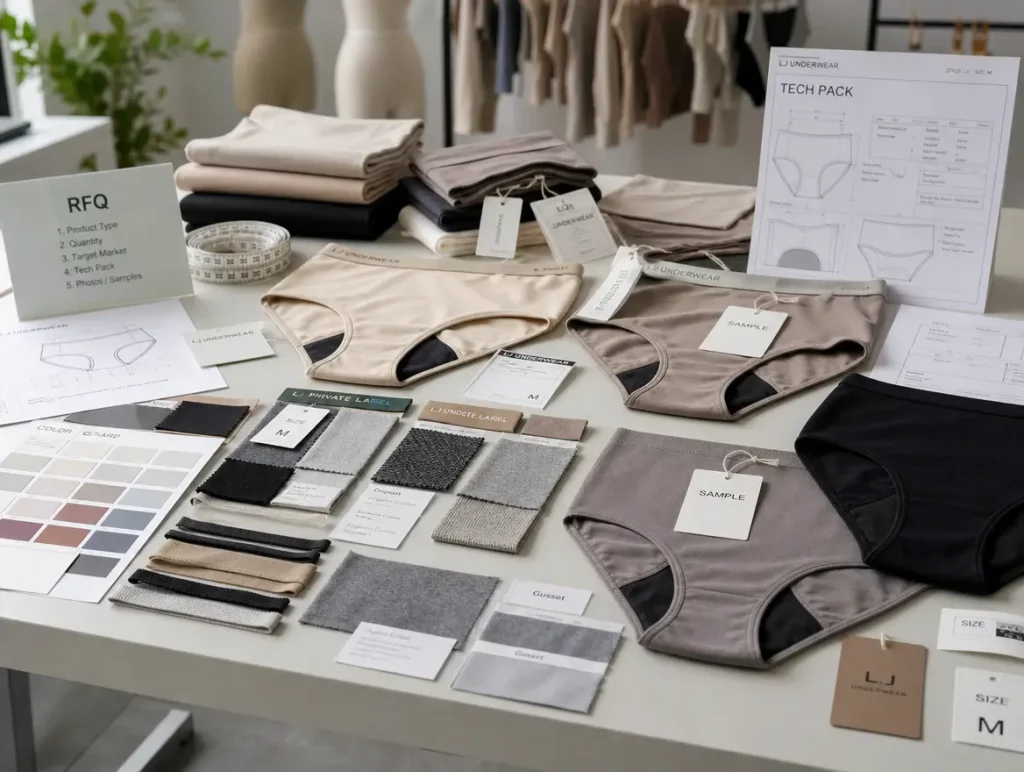
How To Submit Your RFQ
1.Send product type, quantity, and target market.
2.Attach tech packs, photos, or samples.
3.Get sample, MOQ, cost, and timeline guidance.