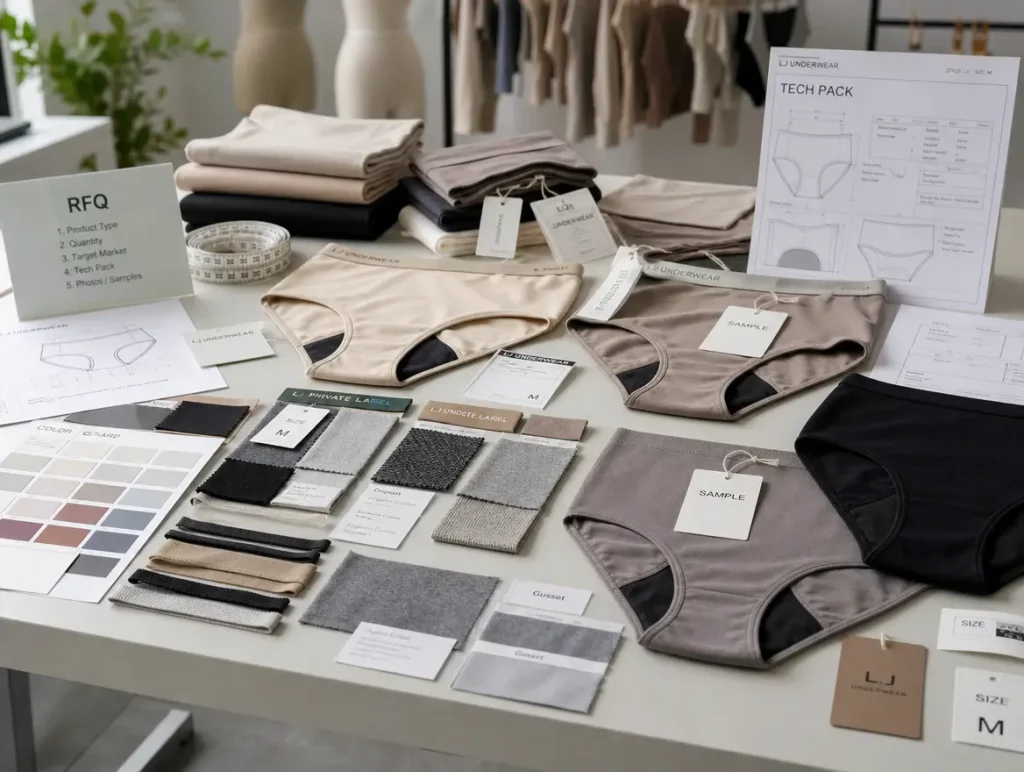
Private-label fit development
Private-Label Fit Guide: From Size Direction to a Confirmed Production Specification
A size chart is a starting point, not an approval. Control four decisions before bulk: target market, product block and grading, material stretch and recovery, and PP-sample approval.

Decision 1 / Target market
Define the Brand's Size Language Before Selecting a Block
Market names route the project, but they are not complete body specifications. Use the buyer's own chart, retailer requirements, return evidence, reference garments, and label plan to define the starting direction.
| Market | Label logic | Unit | Bra band | Cup boundary | Useful buyer input |
|---|---|---|---|---|---|
| US | Even-number labels | Inch | 32, 34, 36 | D, DD, DDD | Customer chart, retailer spec, return data |
| EU | Body-measurement labels | cm | 70, 75, 80 | D, E, F | Body chart and approved conversion |
| AU | Often UK-mapped | cm | Project-defined | UK system where used | Reference garment and PP review |
| UK | US-style bands, UK cups | Inch | 32, 34, 36 | D, DD, E, F | Customer chart and retailer spec |
| Cross-market | EU + US dual label | Both | Both systems | Both named explicitly | Brand conversion and care-label plan |
Decision 2 / Block and grading
Start From the Closest Product Block, Then Grade Point by Point
A block is the base pattern from which the style is developed. The closer it is to the intended construction and material behavior, the fewer avoidable sampling rounds are needed.
| Fit need | Starting block | Likely review |
|---|---|---|
| Everyday briefs | Brief block | Rise, leg, gusset |
| Plus-size briefs | Confirmed plus-size block | Grade increments, side seam |
| Wireless bra | Wireless soft-cup block | Cup depth, strap position |
| Wired bra | Structured wired block | Wire gauge, bridge width |
| Sports bra | Compression or encapsulation block | Impact, strap geometry |
| Shapewear | Compression block | Compression and recovery |
| Maternity / nursing | Extensible maternity block | Panel and closure route |
| Seamless | Knit program | Yarn, gauge, stretch grade |
Decision 3 / Stretch and recovery
Material Behavior Must Match the Approved Fit
Fiber name alone does not predict worn fit. Record the actual knit, elastane, lining, elastic, bonding, finishing, and test method used by the project.
Stretch percentage
State how far the material extends under the agreed method. A brief may target a project-specific range such as 180–220%, but the specification governs.
Return after care
Re-measure after the named wash or care sequence. If 90%+ recovery is required, record it as a project acceptance criterion.
Two-way or four-way
Confirm direction for each panel and stress point; do not assume every cut piece follows the same orientation.
Relaxed and stretched states
Define the measurement state and accepted tolerance. A value such as ±1.5 cm only applies when written into the project specification.

Decision 4 / PP sample approval
Make the Approved PP Sample the Production Reference
The signed PP sample connects the fit decision with bulk measurement and workmanship checks. Resolve open measurement, material, label, and hardware issues before production is released.

| Check | What to verify | Decision to record |
|---|---|---|
| Body fit | Comfort, coverage, support, no unintended gap or pressure | Approve or revise the block |
| Measurements | Each critical POM against its stated tolerance | Approve or adjust the pattern |
| Stretch and recovery | Named test and care sequence; re-measure result | Approve or change material |
| Labels | EU, US, UK, or dual-label language matches the brief | Approve or revise artwork |
| Functional placement | Gusset, liner, support panel, strap, closure, or wire position | Approve or adjust construction |
| Components | Elastic, hook, clasp, clip, wire, bonding, and comfort | Approve or change the component |
From fit direction to order
A Five-Step Route to Production Approval
Send the inputs
Market, product, size range, material direction, reference chart or garment, and tech pack.
Confirm feasibility
Review block availability, grading source, material options, and sampling plan.
Measure and fit
Compare the first sample with the tech pack and log wearer or form feedback.
Lock the specification
Approve measurements, stretch, labels, components, and construction before bulk.
Inspect to the reference
Use the signed PP record for in-process and final measurement and workmanship checks.

The binding quote confirms tooling, quantity, schedule, block or grading support, dual-label option, and inspection scope for the specific project.


Frequently asked questions
Private-Label Fit Guide FAQ
What is a PP sample and why does it matter?
The pre-production sample is the signed project reference for bulk. It records measurements, material behavior, labels, components, construction, and approval status so production and inspection use the same specification.
Can we use our own block instead of an existing factory block?
Yes. Send the approved pattern or reference garment with its measurement and grading source. Once confirmed, the buyer's approved block takes priority over a generic starting reference.
How do EU and US grading differ?
The systems can use different label languages, measurement units, cup progressions, and grade increments. The tech pack should map the intended labels to compatible body and garment rules before production.
What happens if stretch recovery does not meet the PP requirement?
The material route or construction is reviewed before bulk. The project does not treat a generic recovery number as universal; the accepted method and result must be recorded in the PP specification.
How quickly can a project start?
Send the target market, product type, size range, material direction, and reference files. Prepared briefs may qualify for a 72-hour feasibility review; the quote confirms sample timing, MOQ, and the expected 25-45 day bulk route after PP approval where applicable.
Get Your Free Quote & Technical Review
How To Submit Your RFQ
1.Send product type, quantity, and target market.
2.Attach tech packs, photos, or samples.
3.Get sample, MOQ, cost, and timeline guidance.