Adaptive fit & access programs
Custom Nursing Bra Manufacturer For Maternity Brands
A nursing bra is an adaptive system built around one task: let the wearer feed or pump without removing the garment. As an OEM/ODM manufacturer, LJUNDERWEAR engineers the opening route, support structure, and recovery fit to your brand's brief — from clip type to fabric weight — before a single sample is cut.


Direct answer
A Nursing Bra Is an Adaptive System, Not a Standard Bra With One Clip
The access mechanism, inner support, band adjustment and wearer review must work together for the named use case.
State the intended stage, day or sleep context, nursing or pumping need and support intent.
Choose how the cup or front opens, then define the hand movement, exposure and return position to review.
Record the block, base size, cup and band adjustment range, grading plan and selected wearer samples.
Keep comfort, safety and health language within the approved market wording and available evidence.
Use the private-label fit guide to prepare block and wearer-review inputs before quotation.
Nursing bra access
Choose the Nursing Bra Access Style
No opening style fits every brief. Pick one access route — clip, crossover, front or hybrid — then match support and coverage to it.

Use the product image to define the first sample route before comparing alternative openings in the matrix below.
- Confirm clip and strap connection
- Record neckline, band and cup coverage
- Define inner support and return position
| Route to review | Brief priority | Construction questions | Sample approval focus |
|---|---|---|---|
| Drop-cup clip | Defined cup release with the band and inner support remaining in place. | Confirmclip type, cup fold direction, inner sling, strap connection and return position. | Opening movement, hardware contact, coverage, recovery and repeated-use method. |
| Crossover / pull-aside | Soft pull-aside access for briefs that prioritize flexible, low-hardware construction. | Confirmneckline overlap, recovery, exposure, underband stability and sleep/day intent. | Stretch recovery, neckline return, support expectation and movement review. |
| Front opening | Central access or dressing route where front hardware is part of the brief. | Confirmclosure location, lining, edge pressure, security and opening sequence. | Closure handling, contact points, seated movement and care durability. |
| Pumping-access hybrid | A project-specific route where nursing and pumping access are combined. | Confirmequipment context, layer map, opening dimensions and market wording. | Named use protocol, layer recovery, coverage and compatibility evidence. |
Capability boundary: these are development routes to evaluate. Actual constructions, components and product coverage must be confirmed against the project brief and sample evidence.

Access construction
How the Access Point Works
A clip is only one part. Review every piece that moves, carries load or touches skin during opening and return.
Opening hardware
Record the component, orientation, attachment method, contact surfaces and approved supplier reference.
Inner support route
Define the sling or frame, cup connection, coverage and how support is maintained when the outer cup opens.
Return and recovery
State how the cup returns, what shape must recover and which repeated-use or wash method will be reviewed.
Handling requirement
If one-hand use is required, write it into the test method instead of presenting it as an unverified universal claim.
Review skin-contact material direction through the Fabric Guide. For a named 95% bamboo and 5% spandex reference, open the Bamboo Fiber Nursing Bra REACH report. Apply it only to the report's named sample and scope; the quoted project's final fabric, color and trims require separate matching.
Product styles
Nursing Bra Styles to Start From
Start from a real product image. Set the access, support, back and material direction you want reviewed.

Review closure placement, cup access, inner support and skin-contact material direction together.

Record cup depth, strap load, band stability and opening return across the selected size set.

Compare neckline recovery, band distribution, cup coverage and closure handling for daily wear.

Define how the lace overlay, opening panel, inner sling and strap connection work as one system.

Record access movement, coverage, recovery and handling questions for the named wearer context.

Review the front opening together with back coverage, strap spacing and band distribution.
Image boundary: these images already exist in the LJUNDERWEAR WordPress media library. They illustrate development directions; current availability, construction, materials and size coverage still require project confirmation.
Fit planning
Plan Fit for Each Wearing Stage
A maternity-to-nursing range serves more than one context. Review each stage — pregnancy, early nursing, daily and rest — as its own fit condition, not one universal size block.
Pregnancy-oriented brief
Review band extension, cup allowance, strap range, edge pressure and intended support without assuming one block covers every stage.
Early nursing use
Define opening movement, inner support, coverage, closure handling and the named wearer feedback required.
Day-support route
Balance access with band stability, strap load, cup shape and repeatable recovery under the agreed review method.
Rest or sleep route
Confirm whether soft crossover construction, reduced hardware and lower support intent match the actual buyer brief.
RFQ inputs
What to Put in Your RFQ
A useful quote starts with named inputs. Mark unknowns as “To confirm” — don't let assumed sizes or timelines fill the gaps.
| Field group | Information to record | Status |
|---|---|---|
| Use | Pregnancy or nursing context; day/rest; access route; support intent; target market. | To confirm |
| Fit | Block origin; base size; target range; cup/band adjustability; grading; tolerances; wearer panel. | To confirm |
| Components | Clip or opening; inner sling; strap; elastic; closure; lining; seam placement; supplier reference. | To confirm |
| Materials | Body and lining composition; weight; stretch/recovery method; skin-contact requirements; color and care route. | To confirm |
| Testing | Fit/wear protocol; opening-use method; wash and dimensional stability; agreed recovery or durability method. | To confirm |
| Commercial | Style/color/size breakdown; sample stages; packaging; target date; confirmed MOQ, sampling and lead-time basis. | To confirm |
Sample approval
Sample Approval Steps
Close open questions before bulk release. Each gate leaves a traceable decision tied to the exact sample, component and revision.

Define use
Named route, market, wearer and support intent.
Check access
Opening path, hardware, sling and return position.
Review samples
Measurements, tolerances and selected-size balance.
Record feedback
Named movements, contact points and revision notes.
Approve PP
Final sample, BOM, care route and open-point closure.
We do not claim, without project evidence:
Related briefs
Related Products, Separate Briefs
Nursing, maternity, plus-size and postpartum leakproof can sit in one range, but they are not the same procurement brief.
Nursing bra development
Access route, adjustable fit, support intent, components and named-sample approval.
Use the RFQ checklistPlus-size nursing bras
For extended-size programs, review the plus-size nursing bra product category before setting block, grading and size-zone requirements.
Postpartum leakproof underwear
A distinct lower-body and leakproof brief; do not transfer nursing-bra claims or test logic.
Review the postpartum routeBuyer FAQ
Questions Before Sampling
The answers below define the information route; commercial and performance details still depend on the approved project.
What information is needed to quote a custom nursing bra?
A custom nursing bra quotation needs the intended use, target market, opening route, support intent, reference garment or tech pack, initial size range, material direction, quantity breakdown, packaging and required documents. Unknown fields can be marked “To confirm” and scoped during development. Use the RFQ checklist to prepare the brief.
Which nursing access style is best for a private-label range?
No single nursing access style is best for every private-label range. Drop-cup clips, crossover pull-aside fronts, front openings and pumping-access hybrids create different requirements for support, coverage, hardware, handling and recovery. Compare the access styles above against the named wearer and use case.
Can a nursing bra be developed without a finished tech pack?
Yes, subject to project review. Development may begin with a reference sample, sketch and structured brief, but the block source, access construction, materials, measurements, tolerances and approvals still need to be documented before bulk production. The Custom Design ODM route explains this process.
How should nursing bra fit be reviewed as body measurements change?
Fit should be reviewed against named wearer samples, not one assumed universal fitting. Define the target market, body-data source, block origin, base sizes and adjustability, then record cup and band balance, strap range, contact points, access movement and revisions for each sample. Use the Fit Guide for Private Label when preparing block and grading requirements.
What is the typical MOQ and sampling process for custom nursing bras?
Focused nursing-bra programs may start from 50 pcs, category-dependent. A prepared brief may qualify for a 72-hour feasibility review; this is a development-route assessment, not a promise that a physical sample will be completed within 72 hours. Final MOQ, sample stages and timing are confirmed in the project quotation. Review the Low MOQ Program.
Which certifications and testing documents can be provided?
Project-relevant records may include ISO 9001 (certificate 62726Q00153R001), ISO 14001 (certificate 62726E00103R001) and OEKO-TEX® STANDARD 100 certified fabrics (certificate 26.HCN.12213). PFAS-free claims for applicable functional styles—not automatically every nursing bra—are supported by Eurofins report EFW726020391. Each record must be matched to the quoted material, tested sample, target market and validity period. Review Certifications and the Document Center.
Can LJUNDERWEAR develop plus-size nursing bras?
Yes. LJUNDERWEAR can assess plus-size nursing bra programs using a named target market, documented block source, base sizes, grading breaks and selected-size fit reviews. The final size range and construction rules are confirmed for each project. Review the plus-size nursing bra product category.
Prepare the next decision
Turn Your Nursing Bra Idea Into a Reviewable Brief
Share the use case, access route, fit direction, reference product, materials, size plan and required evidence. LJUNDERWEAR can then confirm the appropriate development route and the project-specific commercial terms.
Get Your Free Quote & Technical Review
How To Submit Your RFQ
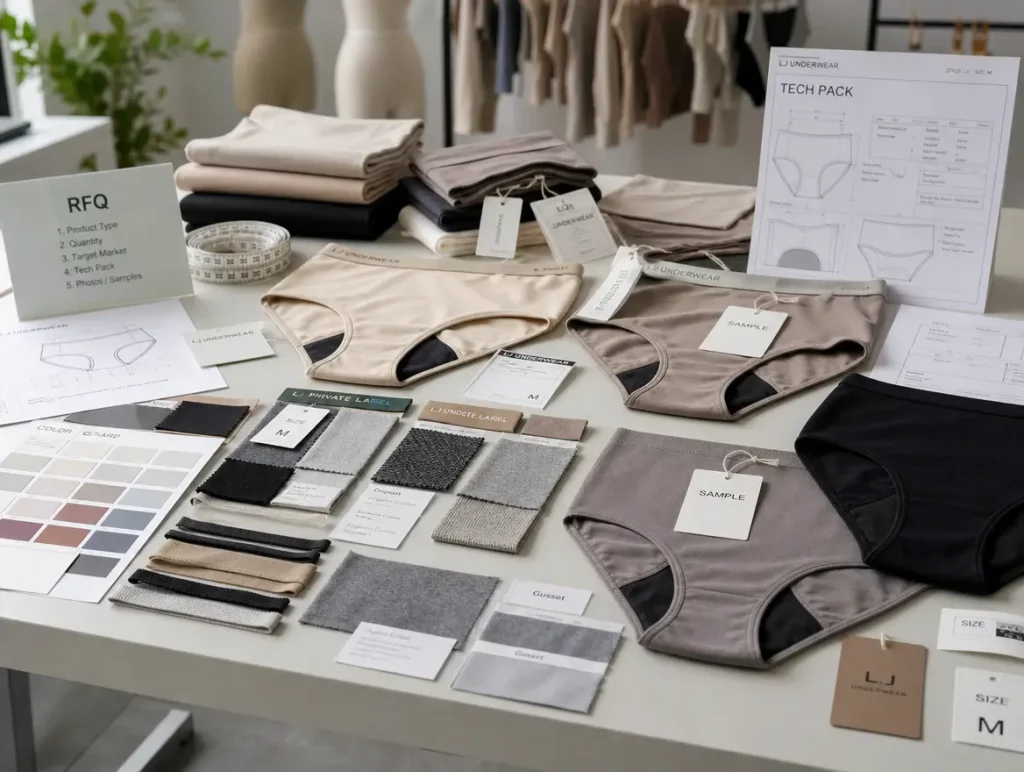
1.Send product type, quantity, and target market.
2.Attach tech packs, photos, or samples.
3.Get sample, MOQ, cost, and timeline guidance.