Activewear product development
Sports Bra Manufacturer for OEM, ODM & Private Label
LJUNDERWEAR develops custom sports bras around activity, support direction, fit, material recovery, ventilation and brand requirements. Each program is reviewed by construction before sampling, grading and bulk-production terms are confirmed.

Activity and support
Compare Sports Bra Construction Routes and Support Methods
Support is not a single fabric feature. It comes from the relationship between cup coverage, compression or encapsulation, underband tension, straps, panels, closures and material recovery. Start with the intended movement and wearer rather than a generic low-, medium- or high-support label.
For cup, band, wire-free and underwire options beyond activewear, review the wider custom bra manufacturer program. Brands planning circular-knit products with mapped support and ventilation zones can also review custom seamless underwear manufacturing.
 Product detail
V-Neck Halter-Back Yoga Tank
Review the EBX5529 product page for its V-neckline, halter-back construction and longer tank-style coverage.
View product Product detail
V-Neck Racerback Sports Bra
Review the EW9300 product page for its V-neck front, wide racerback straps and clean underband construction.
View product Product detail
Strapless Bandeau Sports Bra
Review the CWX8075 product page for its bandeau neckline, strap-free construction and smooth underband finish.
View product Product detail
Scoop-Neck Longline Sports Bra
Review the CY-B-045 product page for its scoop neckline, slim straps, contrast binding and coordinated sportswear styling.
View product Product detail
Plus-Size Front-Zip Cross-Back Sports Bra
Review the Z3WX product page for its front zipper, shaped cup seams, wide underband and cross-back construction.
View product Product detail
Square-Neck Adjustable-Strap Sports Bra
Review the CWX8579 product page for its square neckline, slim straps and clean underband construction.
View product| Construction | How support is created | Development focus | Typical risk to review |
|---|---|---|---|
| Compression | Holds the bust closer to the body through controlled stretch and panel tension. | Fabric modulus, recovery, neckline, underband and strap stability. | Over-compression, restricted breathing or insufficient containment. |
| Encapsulation | Supports each breast through shaped or separated cup construction. | Cup volume, frame, bridge, side support, wire or wire-free structure. | Cup gaping, pressure points or unstable cup-to-band balance. |
| Hybrid | Combines compression with shaped cups or zoned support. | Layer interaction, seam placement, foam, mesh and support-panel transition. | Bulk, heat retention or uneven tension between zones. |
| Seamless | Uses circular knitting and mapped zones for stretch, support and ventilation. | Yarn, knit structure, zone placement, recovery and size grading. | Insufficient zonal control or distortion after stretch and wash. |
Use the product cards to compare published sports bra styles by neckline, strap layout, coverage and underband construction before defining your custom brief.
Fit control
Control Band, Cup and Strap Fit Before Sampling
A sports bra should be reviewed as one support system. A tighter band cannot compensate for an unsuitable cup, unstable strap position or material with poor recovery. For a plus-size sports bra program, representative larger sizes should also be checked for cup volume, strap load, side-wing control and band recovery rather than enlarged proportionally from one base size.

| Review size | Primary question | Record to keep |
|---|---|---|
| Base size | Does the selected construction meet the target fit and movement brief? | Measurement sheet, fit comments and approved changes. |
| Smaller representative size | Do neckline, strap placement, cup volume and band tension remain balanced? | Graded-size measurements and fit observations. |
| Larger representative size | Does the construction provide enough coverage, adjustment and stability without pressure? | Fit and movement review plus required construction changes. |
Use the private-label fit guide to plan measurement ownership, tolerances and graded-size approval.
Material system
Match Sports Bra Materials to Stretch, Recovery and Ventilation Needs
Select the body fabric, mesh, elastic, cup and bonding or sewing method as a connected system. A material should be approved for the required stretch direction, recovery, opacity, hand feel, color and wash conditions—not by fiber name alone.
Body fabric
Nylon-elastane or polyester-elastane options can be reviewed for stretch, modulus, recovery, opacity, print and hand feel.
Power and breathable mesh
Use mesh where ventilation or support-panel control is needed, with compatible stretch and edge stability.
Underband and elastic
Match width, elongation, recovery and skin contact to the target size range and closure route.
Cup and padding
Review removable pads, fixed foam, spacer or laminated structures for coverage, heat, shape and wash behavior.
Straps and hardware
Specify strap stretch, adjustment range, rings, sliders, hooks or clips with the expected load and use.
Construction method
Choose sewing, bonding or a combined route after checking seam strength, edge comfort and material compatibility.

| Component | Approval focus | Risk when poorly matched |
|---|---|---|
| Body fabric | Stretch, recovery, modulus, opacity, moisture handling and color behavior. | Loss of support, show-through, distortion or inconsistent fit. |
| Mesh and support panels | Zone placement, compatible stretch and edge stability. | Uneven tension, chafing or panel deformation. |
| Elastic and underband | Elongation, recovery, width, plush surface and seam compatibility. | Roll-up, pressure, poor size consistency or early relaxation. |
| Cup or padding | Thickness, shape, position, recovery and wash retention. | Visible ridges, shifting, collapse or asymmetry. |
| Bonded or sewn edge | Adhesive or stitch compatibility, strength, bulk and skin contact. | Delamination, broken stitches, hard edges or waviness. |
Review the fabric guide before locking the material brief, test requirements and color-development route.
Approval controls
Approve Fit and Movement Before Bulk Production
Static fit, movement observations and garment measurements answer different questions. Record each against the approved sample and intended activity so a visual comment is not mistaken for a formal performance claim.
| Control point | What to review | Suggested record |
|---|---|---|
| Garment measurements | Underband, neckline, cup, body length, strap length and panel position against tolerance. | Measurement sheet and revision history. |
| Static fit | Coverage, pressure, gaping, underarm clearance, strap comfort and closure position. | Fit comments with sample and wearer identity. |
| Movement review | Strap movement, band roll-up, neckline stability and containment during intended activity. | Movement notes or approved video reference. |
| Material recovery | Return after stretch, elastic response and panel stability. | Material and component approval. |
| Construction | Stitch security, bonded-edge integrity, cup symmetry and padding position. | Workmanship checklist. |
| Production reference | Final materials, colors, components, labels and packaging. | Sealed sample and approved bill of materials. |
Development workflow
Develop a Sports Bra From Brief to Bulk Approval
The workflow connects design intent with measurable approvals. Molded cups, custom elastic, special hardware, extended sizing and new material development can change the sample sequence and commercial terms.
Define the brief
Activity, support, market, size system and positioning.
Check feasibility
Cup, band, strap, panel, closure and material route.
Build the tech pack
POM, tolerances, components, artwork and packaging.
Develop sample
Compare construction and measurements with the brief.
Review fit
Document movement and representative-size changes.
Lock reference
Approve BOM, colors, trims, labels and sealed sample.
Plan inspection
Define measurements, workmanship and packing checks.


See how responsibilities are divided through custom design ODM and how revisions are controlled through sampling development.
Production evidence
Verify Workmanship, Documents and Production Records
Quality control should connect the approved sample, bill of materials and measurement standard with observable production checks. Certificate numbers are document references—not blanket proof for every sports bra, material or order.
Sports-bra bulk checks
- Cup and padding symmetry
- Strap length, position and adjustment range
- Underband measurement and elastic response
- Side-wing, mesh and support-panel placement
- Stitch security or bonded-edge condition
- Hardware, logo and care-label placement
- Finished measurements and packing match
Project file outputs
- Applicable certificate or supplier document
- Approved bill of materials
- Measurement sheet and fit comments
- Representative graded-size record
- Sealed-sample reference
- Artwork, label and packaging approval
- Final inspection summary when agreed
| Document | Reference | Correct project use |
|---|---|---|
| OEKO-TEX® STANDARD 100 | 26.HCN.12213 | Use only when the selected project article or component is within the document's current named scope. |
| ISO 9001 | 62726Q00153R001 | Reference the quality-management system within its stated scope; it is not a product-performance certificate. |
| ISO 14001 | 62726E00103R001 | Reference the environmental-management system within its stated scope; it does not certify an individual sports bra. |
Scope control: Eurofins report EFW726020391 concerns a tested TPU barrier-film sample for leakproof products. It does not substantiate ordinary sports-bra fabric, elastic, foam, mesh or a blanket PFAS-free claim. Review document routes on certifications and manufacturing context through the factory overview.
Buyer inputs
Prepare a Sports Bra Brief That Can Be Quoted
Provide enough information to separate confirmed requirements from open development decisions. Commercial quantities and timing remain style-specific until feasibility, material availability and the required approval sequence are understood.
- Target activity and support direction
- Reference style, sketch or technical drawing
- Target market and size system
- Base-size measurements or fit block
- Body fabric, mesh, elastic and cup preferences
- Strap, closure, hardware and branding needs
- Colorways, artwork and packaging
- Estimated quantity by style, color and size
- Target launch date and delivery market
- Required certificates or reports
What the initial review should return
A useful quotation should state what is confirmed, what is proposed and what remains subject to sample, document or commercial approval.
Buyer questions
Frequently Asked Questions About Custom Sports Bra Manufacturing
How is sports bra support approved before bulk production?
Support is approved against the intended activity, agreed construction and selected sample sizes. The review can include garment measurements, static fit, movement observations, band stability, cup containment, strap movement and material recovery. A formal performance claim requires a defined method, sample identity and acceptance criteria.
Should a custom sports bra use alpha sizing or band-and-cup sizing?
Pullover and soft-compression styles often use alpha sizing, while structured or cup-specific programs may use a band-and-cup matrix. The choice depends on the construction, target market, fit block and grading plan rather than one rule for every sports bra.
What is the MOQ for custom sports bras?
Selected sports bra programs can start from 50 pieces per style per color when available materials and an existing construction route are used. Custom-dyed fabric, molded cups, branded elastic, special hardware, complex size ranges or fully new construction may require a higher MOQ. The final quotation confirms the minimum for each style, color and size plan.
How long does sports bra sampling take?
Sampling time depends on the completeness of the tech pack, material availability, cup or hardware development, size range and number of fit rounds. The plan should separate the first prototype, fit revisions, graded-size review and pre-production approval.
Which fabrics are suitable for custom sports bras?
Common options include nylon-elastane or polyester-elastane body fabrics, power mesh, breathable mesh, spacer or laminated cup materials and style-specific elastics. Selection should follow the support, recovery, ventilation, print, colorfastness and wash requirements of the intended activity.
Can custom sports bras use OEKO-TEX® materials?
They can use materials supported by matching OEKO-TEX® documentation. LJUNDERWEAR document reference 26.HCN.12213 must be checked for holder, validity and named article or component scope before it is applied to a sports-bra project or claim.
Do you support OEM, ODM and private-label sports bras?
Yes. OEM begins with the buyer's design and specification, ODM includes design-development support, and private label adds buyer-owned branding and packaging. Responsibilities, supplied files and approval points should be recorded before sampling.
Can sports bras be developed with seamless construction?
Yes. A seamless program may use circular knitting and mapped zones for support, ventilation and recovery. Structured cups, underwire, special closures or other requirements may still call for cut-and-sew or combined construction.
Start the project
Request a Sports Bra Development Review
Send your activity target, support direction, reference style, size plan, materials, estimated quantity and launch timing. LJUNDERWEAR will identify the inputs required for feasibility review, quotation and sampling.
Selected styles can start from 50 pieces per style per color. The final MOQ, sampling time, production timing and evidence requirements are confirmed for each project.
Get Your Free Quote & Technical Review
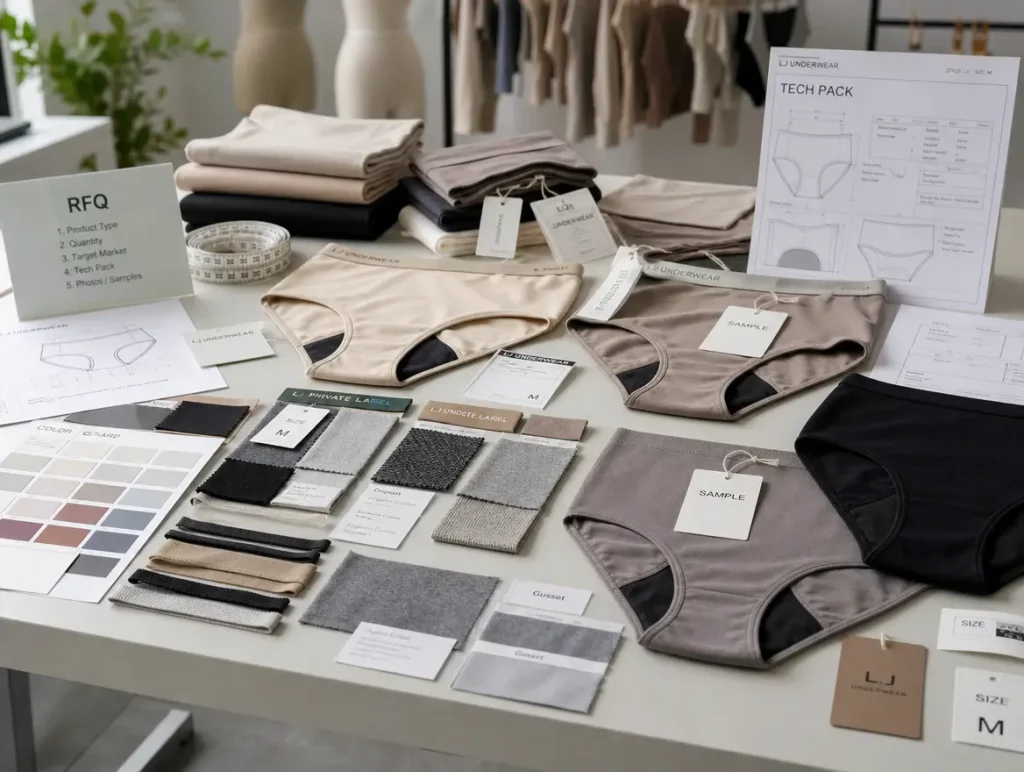
How To Submit Your RFQ
1.Send product type, quantity, and target market.
2.Attach tech packs, photos, or samples.
3.Get sample, MOQ, cost, and timeline guidance.